
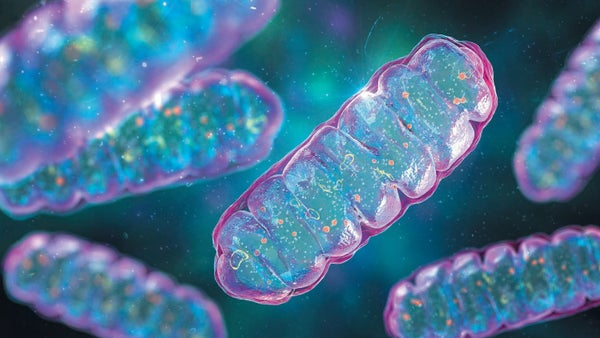
Almost every type of human cell is powered by mitochondria, bean-shaped organelles that use oxygen to synthesize usable energy.* These structures evolved billions of years ago from free-swimming bacteria that were engulfed by some of humanity's earliest ancestors. Because of this history, mitochondria still have their own ring-shaped DNA—completely separate from the 23 chromosomes that make up most of the human genome. And although those chromosomes come from both parents, nearly all humans inherit their mitochondrial DNA (mtDNA) from their mother's egg cell.
So what happens to the mtDNA in the sperm cell? Understanding this process is important for studying mitochondrial diseases, genetic disorders that result when these “powerhouses” don't function properly. Scientists know that molecular processes break down the sperm's mitochondria soon after fertilization in other animals—but no one has been able to pinpoint when this elimination happens in humans.
Now biologists have discovered that it happens early—in fact, human sperm's few mitochondria contain virtually no DNA at all. The findings were published in a recent issue of Nature Genetics. “We were very surprised by the absence of mtDNA in mature human sperm” because previous studies had produced conflicting results, says the study's senior author, molecular biologist Dmitry Temiakov of Thomas Jefferson University in Philadelphia. This mtDNA-elimination process might play a role in human infertility and can help science understand mitochondrial diseases, he says.
On supporting science journalism
If you're enjoying this article, consider supporting our award-winning journalism by subscribing. By purchasing a subscription you are helping to ensure the future of impactful stories about the discoveries and ideas shaping our world today.
Using molecular biology and microscopy techniques, the researchers examined human sperm cells across their developmental stages. They showed that mitochondria in the sperm's precursor cells did contain DNA, along with an important protein called mitochondrial transcription factor A (TFAM) that maintains and protects that DNA. But when the sperm cells matured, a slight chemical change prevented TFAM from entering their mitochondria. Instead it entered the nucleus, where it could no longer prevent the mtDNA from degrading.
If mtDNA sticks around in sperm's mitochondria, it could become a source of infertility. Previous studies showed that people with decreased sperm counts and motility have elevated amounts of mtDNA in those cells.
Mouse studies have indicated that TFAM is absent in sperm's mitochondria, says Xinnan Wang, a mitochondrial cell biologist at the Stanford University School of Medicine. The new study, along with prior research in other animals that found paternal mtDNA can be eliminated after egg fertilization, “shows multiple mechanisms that may contribute to maternal mitochondrial inheritance in different organisms,” she says.
Temiakov says there are probably other, yet unidentified mechanisms that regulate mtDNA in different cells and that might contribute to mitochondrial diseases if disrupted. “We need to uncover these mechanisms,” he says, “to better understand mitochondrial diseases and how to treat them.”
*Editor’s Note (3/7/24): This sentence was edited after posting to correct the description of the human cells that are powered by mitochondria.